What gets checked on every build.
In my method, these checks apply to every build, whoever does the building:
- Every step that can’t be undone is checked on its own before it happens.
- Your old way of working stays available until the new set-up has taken over.
- It’s checked on your real account, live. If something can only be checked on a test copy, I tell you so.
- Anything set to run on a schedule counts as working only after it has run for real once.
- Anything that collects leads or personal details is tested end to end, including the message that tells you a new one came in.
- Anything that has to keep running comes with an alarm, and I test that the alarm reaches you.
How the work is checked.
In my method, every deliverable is checked by an independent AI reviewer: a fresh AI session that didn’t write the work. It looks for what’s wrong and asks: would you already know this? If so, it isn’t good enough.
Before anything reaches you, one last AI reviewer reads it the way you will, checks it against your own words and checks every company or person it names. A problem sends the work back to be fixed.
AI researchers and reviewers do much of the work. I approve everything that reaches you, and if I find something that would change the answer, I tell you before the final write-up.
When something goes wrong in my own work, I fix the method, so the fix carries into the next project.
A fresh AI session grades it
- Does what was askedPass
- Checked, not assumedFail: back with the findingsPass
- Ready for the clientPass
Pass: forward
- A last AI reviewer
- reads it the way the client will
- The client
- reads it and agrees or pushes back
Proven on my own businesses first.
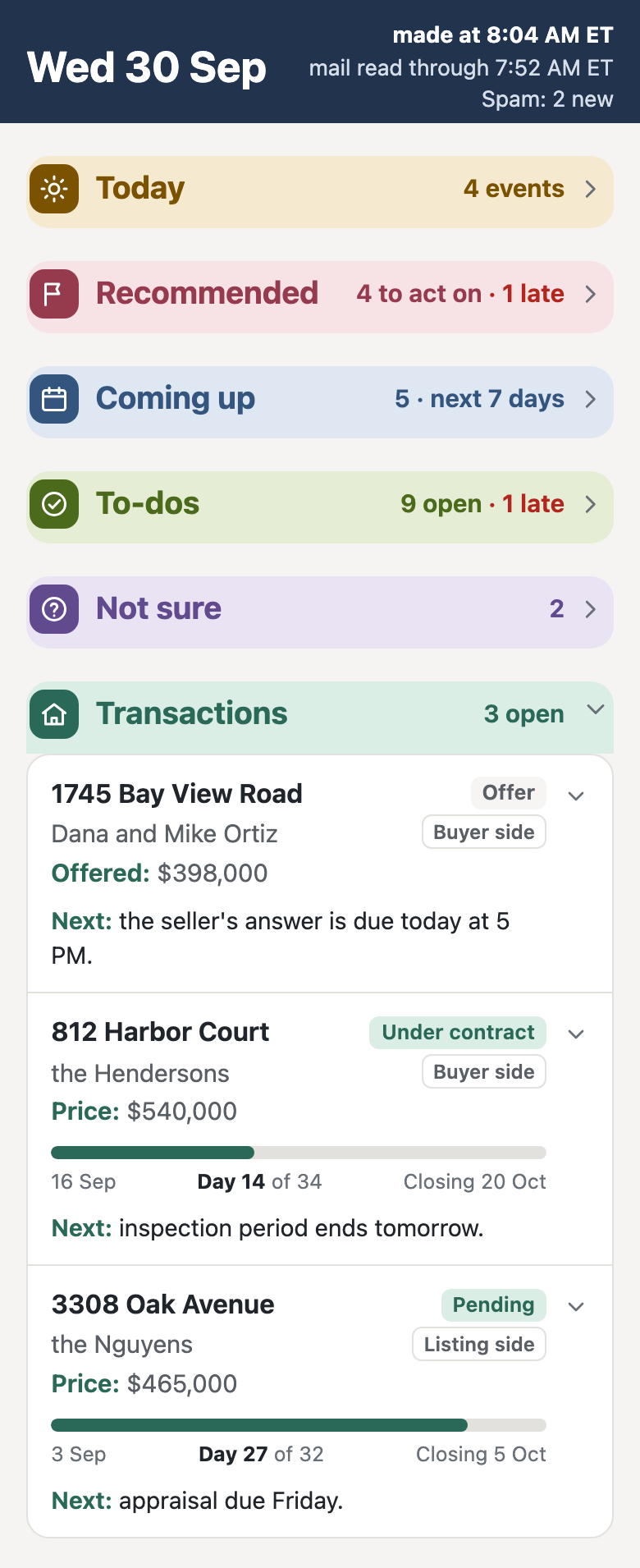
I build AI systems for real businesses, and I prove them on my own companies first. I rebuilt a real estate website with AI, and I use the AI set-up I built for real estate agents on my own listings.
My own systems are built the same way: AI agents I set up built them, reviewed them and now maintain them, with an independent AI reviewer checking the work.
What stays yours.
What I build runs on accounts in your name. That’s how a forward deployed engineer works at the big AI companies; I do it at the size of your business.